Guide
Getting progress claims and variations paid
Agree how work will be measured and approved before the job starts, keep site records that back up every claim and variation, and submit complete claims on time.
- Published
- Reading time
- 3 min read
Why claims get held up
Late or short payment on claims strains your cash flow and your relationship with the client. In most cases the person assessing your claim wants to administer the contract fairly. Problems usually come from the two sides not agreeing how work is measured, what evidence is needed or how out-of-scope work is handled. Most of that can be settled before the job starts.
Step 1: agree the rules before the job starts
Read the contract and understand your obligations. If a term does not work for both sides, raise it with the client and explain why. Have your insurances, bank guarantees and other documents in order.
Then ask the person who will assess your claims:
- How will completed work be assessed? By you and the superintendent, or by a quantity surveyor?
- What documents do they need to support a claim?
- What are the timeframes, so payments are not delayed?
- For out-of-scope work, what approval do they need before you start, and what documents after you finish?
- What else would make your claims easier for them to assess?
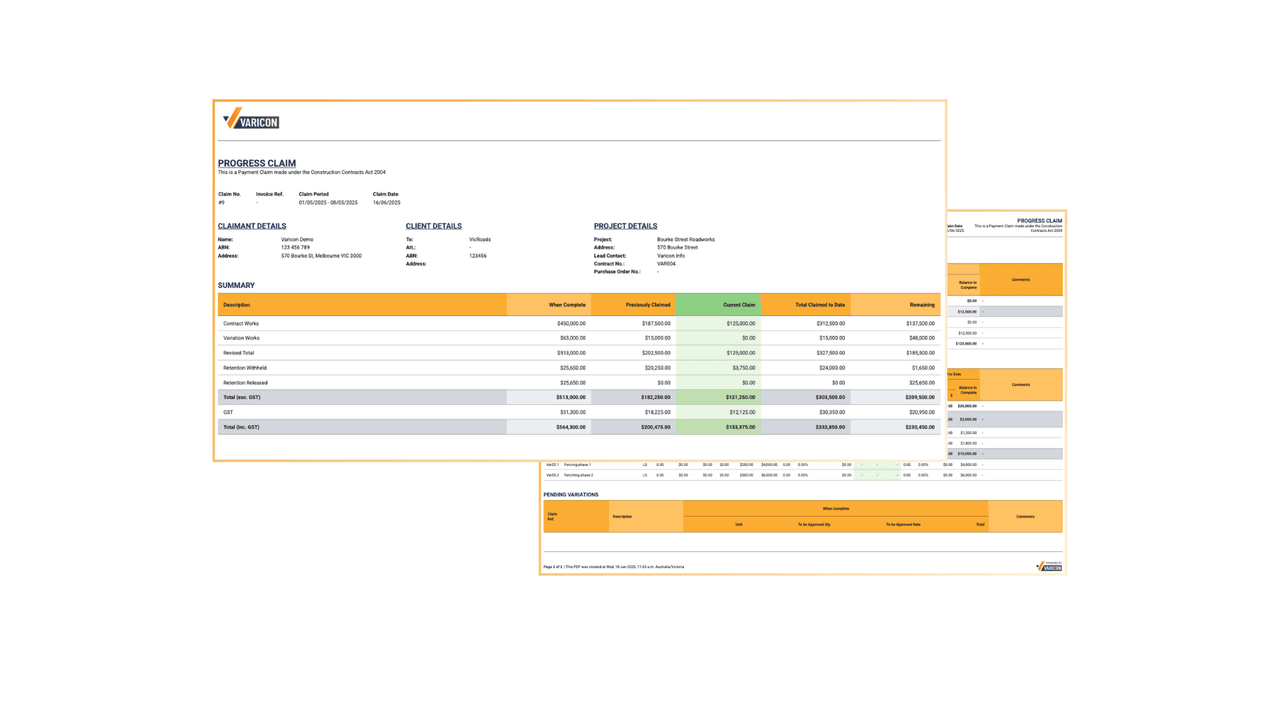
Set up your claim template, contract schedule and variation template before the first claim is due, and check the payment details in them against the contract and the legislation that applies to your job.
Step 2: keep one system for claims and the records behind them
Keep progress claims, variation requests, dayworks and daily site records in one place, with one current version of each. Most disputes are prevented by good communication and good records. When one does happen, those records get it resolved faster.
Step 3: deal with variations as they happen
Tell the client as soon as you see work that is outside the original scope. Before you start it, get documented approval that it is out of scope, and agree whether it will be priced or done at day rates.
- If it is priced, aim to have the variation approved before the work starts. If the work has to start first, get the approval as soon as you can.
- Request an extension of time if the change affects the program and your contract allows it.
- If it is done at day rates, fill in a dayworks docket and get it signed by the superintendent. If they are not on site, send the docket and any supporting documents to them.
- If a docket is not signed on the spot, keep the correspondence, so you can still claim it if approval does not come within the time the contract allows.
A contract done fully on dayworks is not a blank cheque. Make sure the scope of work you do on day rates is approved, by the head contractor’s supervisor or project manager if you are a subcontractor, or in writing by the client if you are the head contractor.
Step 4: agree the claim before you submit it
Where the contract allows, talk the claim through with the superintendent first. That can be as simple as sending your draft calculations or a short conversation. Agree completed work zones with the client as the job goes, so the final approval is quicker.
Submit the claim close to the due date, with all the supporting documents in a format that is easy to check. That can include dayworks dockets, quantity assessments and QA records. Follow up if the claim is not approved on time.
Step 5: close out the job
At practical completion, as your contract defines it, claim the release of retention or bank guarantees. Set a reminder for the final release at the end of the defects liability period.
Civil contractors often work for the same clients for years. After the job, sit down with the client and talk through what went well and what both sides could do better next time.