Claims and variations
Get paid faster with progress and variation claim best practices
- Published
- Updated
- Reading time
- 3 min read
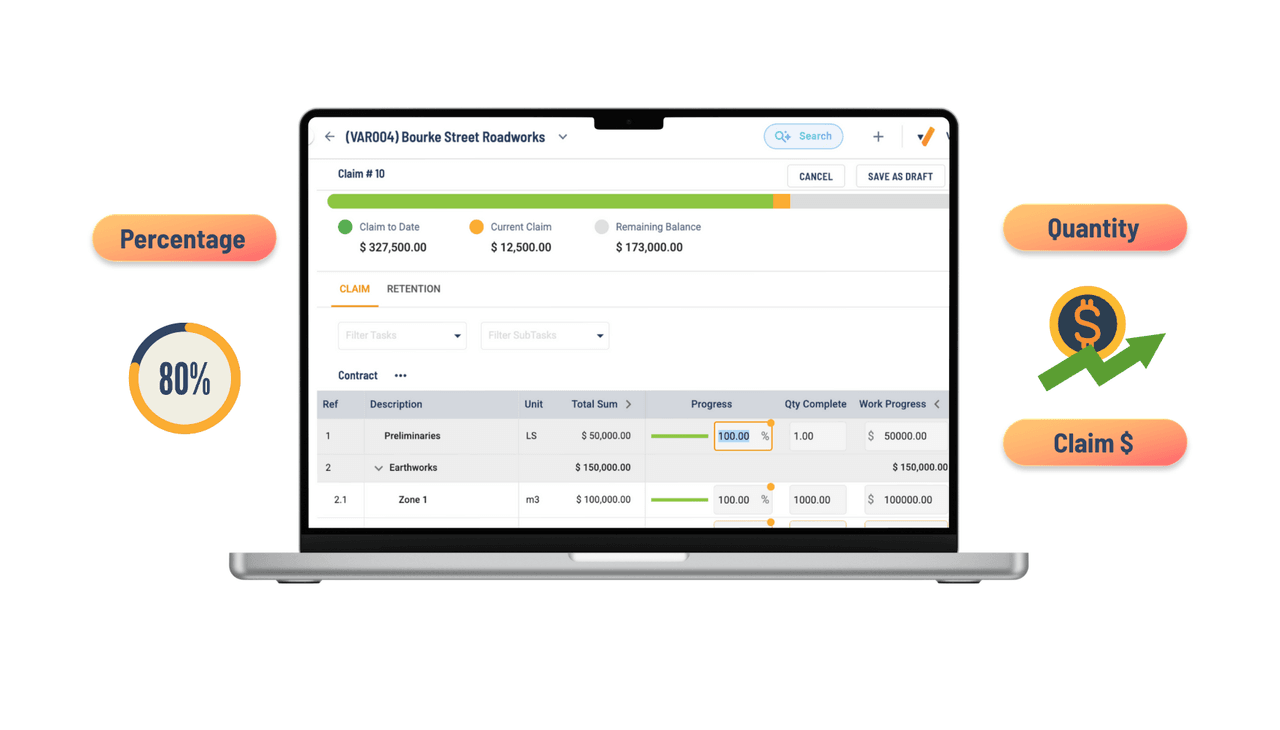
With thin margins and high costs, getting paid promptly is critical to cash flow in civil construction. To be paid properly, you need to be on top of your progress claims and variation claims.
Whether you work for a government department, a property developer or as a subcontractor on a major project, you most likely lodge variation claims to be paid for work outside the original scope, and progress claims to get paid as the job goes. These claims are often a source of friction with your customers, but they do not need to be. A few simple practices will get you paid faster while keeping a good relationship with your customer.
Before the project starts
Good contract management starts well before you break ground. Too often, civil contracts are signed without enough thought about the contractor’s obligations and how your customer (the principal) will pay you through the job.
That is a recipe for disputes, late payment and strained relationships. In our experience, most principals do not set out to treat contractors unfairly. But contracts are often managed by inexperienced staff who do not fully understand good practice.
Before the project starts:
- Fully understand your contract and your obligations. If you see problems, raise them with the principal and explain why the terms do not work for both sides.
- Make sure everything is in order, such as insurance, bank guarantees and certifications.
- Agree with the principal how progress on each contract item will be measured, how they expect progress and variation claims to be submitted, and how long approval and payment will take.
- Agree how variations will be handled, especially if you are expected to start variation work before the variation is approved.
- Set up your templates, including your contract schedule and variations template, and check that all your contract and security of payment details are correct.
During the project
If you have talked things through with the principal before the job starts, you should already be set up well.
Good contract management during the job is mostly good communication with the principal. Most issues can be resolved if you:
- communicate early and often
- give supporting information in a clear, well-organised format
- show why your request is within the contract and the law, and why it is fair.
If you see anything you believe is outside the original scope, tell the principal as soon as possible. Ideally, meet the superintendent and their technical representative on site to work through it. If the variation work is done on a cost-plus or daywork basis, keep very good records as the work progresses.
For progress claims, ideally get in-principle agreement from the principal before you submit. Where you can, agree completion of each work zone as you go, and how much you are entitled to claim. That makes final approval simpler and quicker. Submit your claims as close to the due date as you can, with all the supporting documents. If you agreed how progress will be measured before the job started, this should be straightforward for both sides.
At practical completion, as defined in your contract, do not forget to claim the release of your bank guarantee or retention. If needed, set a reminder for the final release at the end of the defects liability period.
After the project
Civil contractors often work with the same principals for many years. A long-term relationship is in everyone’s interest, so your contract management does not end with the job.
When the job is finished, follow up with the principal to discuss what went well and what both sides could do better. It builds trust and helps make the next job even better.
How Varicon helps
Varicon’s founder, James Baker, spent more than a decade as a civil construction project manager, operations manager and superintendent for a range of civil contractors and government asset owners. Varicon brings your cost and contract information together, and builds progress claims and variations from approved site records.
If you still manage costs and contracts in Excel, see how progress claims and variations work in Varicon, or book a demo.