Cost management
How accountants and bookkeepers using Xero can help construction clients protect their margins
- Published
- Reading time
- 5 min read
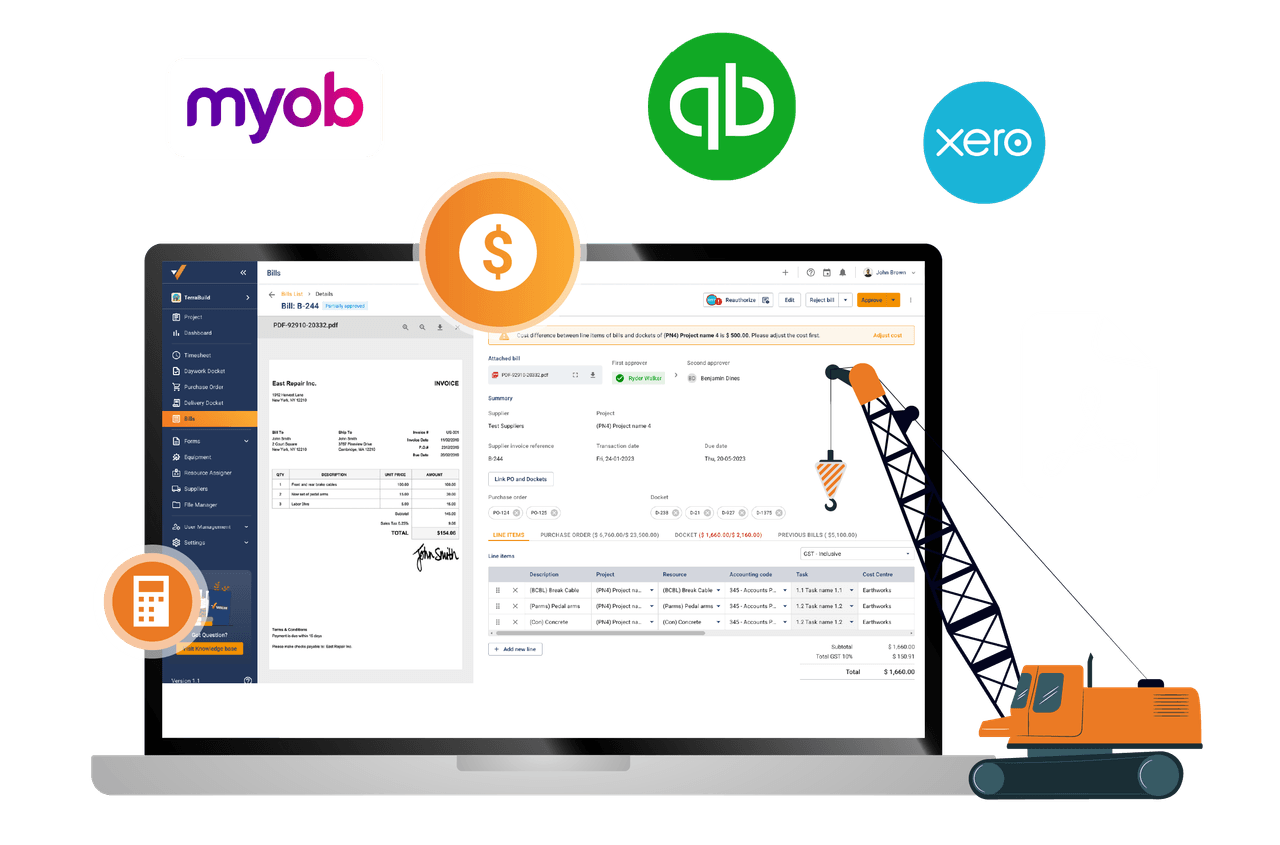
Xero does a great job of managing the books for civil contractors. What it was not built for is the job itself: work that spans several sites, subcontractors and cost codes, where one missed docket or late invoice can throw cash flow off course.
This article is about that gap between Xero and the site, and how accountants and bookkeepers can close it for their construction clients. For five practical steps that apply whatever accounting system a client uses, see 5 ways accountants and bookkeepers can help construction clients stop margin erosion.
If your clients rely on spreadsheets, late timesheets or paper delivery dockets, you already know how easily the picture breaks down. By the time information reaches the office it is often days or weeks old, too late to fix the problem.
Why construction accounting is so complex
Construction accounting and project cost control are closely connected, but they are not the same thing. Projects run for months, involve dozens of suppliers and produce a constant flow of costs from different teams and locations.
Every project has its own moving parts: materials, equipment, labour and subcontractors, and the numbers shift daily. Without accurate, current data, even the most careful accountant cannot see where the money is going.
Common problems include:
- Scattered cost tracking. Site teams log hours and materials on paper or in separate spreadsheets, and someone types it into Xero later, which adds delays and mistakes.
- Manual data entry. Every time a docket or invoice is re-entered, small errors creep in, and across dozens of jobs they add up.
- Slow invoice checks. Without automation, every purchase order, delivery docket and invoice is matched by hand.
- Out-of-date reporting. By the time data is entered and reconciled, it is old, so margin losses stay hidden until the job is finished.
For firms using Xero, this makes job costing feel like guesswork. The accounting data is clean, but the inputs feeding it often are not.
The case for capturing costs as they happen
Imagine if dockets, timesheets and invoices from site reached the office the day they were recorded. No double handling and no waiting for someone to upload a spreadsheet.
That is the job of a construction-specific system like Varicon. It sits between the site and the accounting system. Site teams record hours, materials and dayworks on their phones or tablets, and the office sees them once they are submitted.
With that information, you can:
- spot overruns early, before they turn into losses
- compare actual costs against budget
- plan cash flow from current figures
- give advice that helps clients act before a problem grows.
How Varicon works
Varicon is built in Australia for civil contractors, and for the accountants and bookkeepers who support them. It works with Xero and MYOB, and keeps every cost, from labour to materials, in one place.
- Mobile data capture. Site teams use the Varicon app to record delivery dockets, timesheets and dayworks. The design is fat-finger friendly, with big buttons and simple fields, so entries are quick on site.
- Bills checked before approval. Varicon checks supplier invoices against purchase orders and delivery dockets, and flags anything that does not match, so overpayments are caught before they are paid.
- Works with Xero. Bills and purchase orders sync to Xero, and approved hours flow to payroll in Xero. Your clients keep the system they already know, and you get cleaner data with no retyping.
- Dashboards. See current project costs and commitments, and compare spend against budget to spot trends and risk early.
The result is one system that connects site and office, so you and your clients can see where you stand on every job.
Why accountants and bookkeepers should care
When cleaner data flows into Xero, your role changes. You are no longer only reporting on what happened, you are helping shape what happens next.
With Varicon, you can:
- turn messy cost data into clear financial insight
- give clients advice on project performance and cash flow before month end
- close the month with fewer manual adjustments
- add value to every construction client you support.
For bookkeeping practices that specialise in construction, it is a way to move into advisory work without adding staff or hours. For accountants, it strengthens client relationships by helping clients make better business decisions, not just keep cleaner ledgers.
A typical scenario
Say one of your clients runs three construction projects at once. Each has several subcontractors and suppliers, with materials arriving daily.
Without Varicon, the foreman drops off dockets every Friday. You spend hours matching them to invoices and updating Xero. By the time you know Project A is over budget, it is two weeks too late.
With Varicon, each cost is recorded the day it happens. You see that Project A’s material spend jumped 12% this week and tell your client straight away. They adjust their ordering, avoid further overruns and protect their margin.
That is the difference between reacting and being in control.
Fits the way you already work
One of the biggest barriers to new software is change. Varicon works with the accounting systems your clients already use.
If your clients are on Xero, they do not leave it. Varicon feeds it checked bills and approved hours. For you, that means no new ledger to learn and no double entry.
The benefits:
- Accuracy. What is entered and approved on site reaches Xero without being retyped.
- Faster approvals. Invoices and dockets move through approval in one system.
- Time back. Fewer hours spent reconciling accounts and chasing paperwork.
- One set of records. Accountants, site teams and project managers work from the same information.
The bottom line
In construction, profit comes down to control, and control comes from visibility.
If your clients cannot see their true costs until weeks after they are incurred, they are always a step behind. When site activity is connected to Xero through Varicon, every cost, hour and material is recorded as the job runs.
For accountants and bookkeepers, that is a chance to move beyond compliance and become part of your clients’ success. Margins in construction are tight, and with Varicon and Xero working together, you and your clients can see where each job makes or loses money.
Book a demo to see how it works.